Category: Family Court

  • Do Family Courts Favor Mothers? Examining the Data

    Do Family Courts Favor Mothers? Examining the Data

    Do Family Courts Favor Mothers?

    A common claim in custody discussions is that U.S. family courts automatically favor mothers. That claim does not hold up well when examined alongside how most custody cases are actually resolved and what available research shows about contested litigation. A more accurate picture is that most parenting arrangements are never decided by a judge after trial, and the smaller subset of heavily litigated cases often involves allegations of abuse, alienation, or both.

    How Custody Cases Are Resolved

    Most custody matters do not end in a courtroom trial. Research commonly cited in family law discussions indicates that roughly 85% of custody cases are resolved by mutual agreement outside of court, while about 15% proceed as contested cases requiring judicial resolution. That distinction matters. When people point to a supposed court bias, they often overlook that the large majority of parenting plans are negotiated by the parents themselves, sometimes with help from lawyers, mediators, or other professionals.
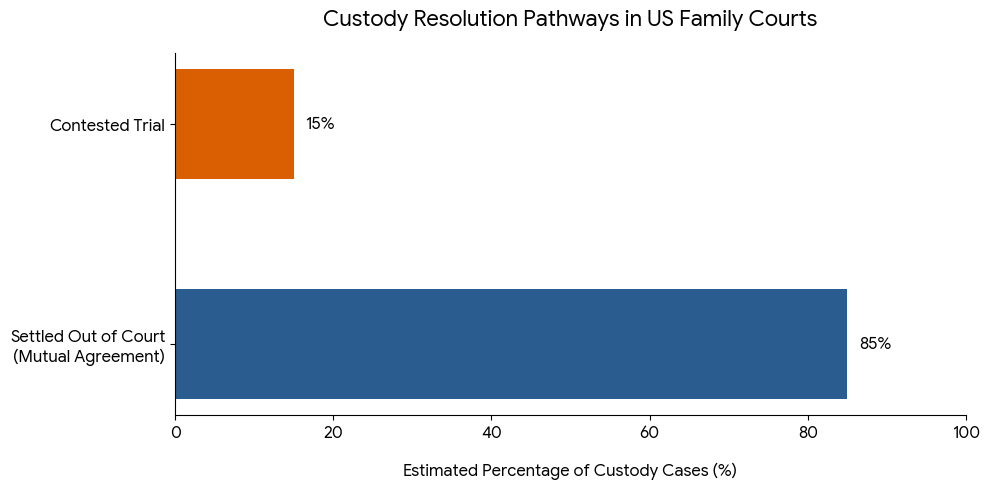
    Horizontal bar chart titled Custody Resolution Pathways in US Family Courts showing 15 percent contested trial and 85 percent settled out of court by mutual agreement.
    Custody resolution pathways in U.S. family courts.
    • About 85% of cases are settled out of court by agreement.
    • About 15% of cases become contested matters decided through litigation.

    In other words, many custody outcomes reflect parental bargaining, financial realities, safety concerns, work schedules, and strategic decisions made long before a judge issues any ruling.

    Why Contested Cases Look Different

    The minority of cases that do become contested are not representative of the average family court matter. These cases often involve serious factual disputes, competing narratives, and allegations that raise the stakes for both parents and children. In contested custody cases studied in the literature, approximately 38.5% include allegations of general abuse, and about 15% include allegations of child sexual abuse.

    Contested custody litigation is a narrow and unusually high-conflict slice of family court practice, not the norm.

    That context is important because broad claims about courts favoring one gender can be misleading when drawn from a population of cases that is already atypical and highly escalated.

    What the Research Says About Outcomes

    Available research on contested custody cases also complicates the idea that mothers are categorically favored. In the contested cases discussed in this body of research, mothers lose custody about 27% of the time when they allege general child abuse. When a case includes an alienation claim in addition to a child abuse allegation, that figure rises substantially, with mothers losing custody about 51% of the time.
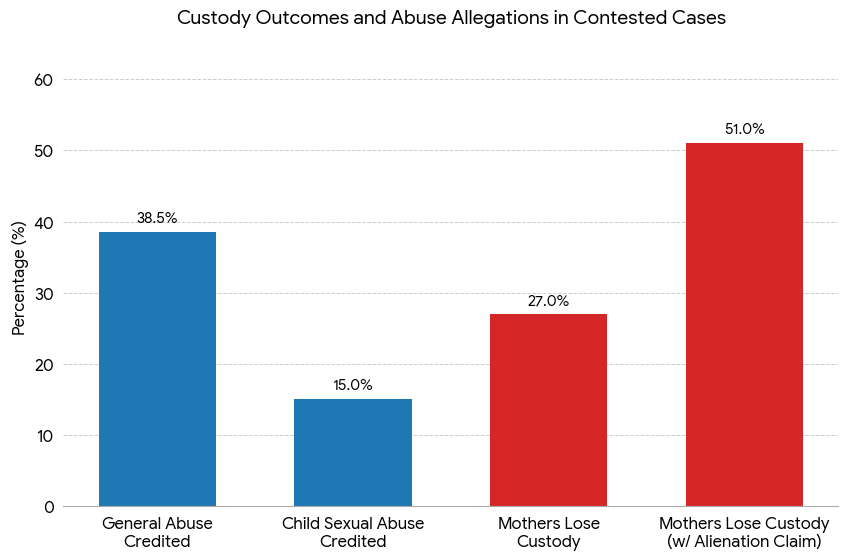
    Bar chart titled Custody Outcomes and Abuse Allegations in Contested Cases showing percentages for general abuse credited, child sexual abuse credited, mothers lose custody, and mothers lose custody with alienation claim.
    Custody outcomes and abuse allegations in contested cases.
    • In contested cases alleging general child abuse, mothers lose custody about 27% of the time.
    • When there is a child abuse allegation plus an alienation claim, mothers lose custody about 51% of the time.

    These figures do not prove that courts favor fathers, just as other statistics do not prove that courts favor mothers. What they do show is that the reality is more complex than a simple bias narrative. Outcomes can shift significantly depending on the allegations raised, the evidence presented, the credibility findings made by the court, and the legal standards applied in a given state.

    The Better Question

    Rather than asking whether family courts favor mothers as a rule, a better question is how custody decisions are shaped by settlement dynamics, litigation posture, evidentiary burdens, and child-safety concerns. Most families never receive a trial verdict. Of those that do, many are dealing with abuse allegations, alienation claims, or other severe conflict that makes simple generalizations unreliable.

    For parents trying to understand the process, the takeaway is clear: custody outcomes are driven by far more than gender alone. Preparation, documentation, credibility, and case strategy matter. So does recognizing whether a case is likely to settle or become one of the relatively few disputes that a judge must decide.

    References

    • U.S. Census Bureau, Custodial Mothers and Fathers and Their Child Support (commonly cited in discussions of negotiated custody arrangements and parenting outcomes).
    • Joan B. Kelly, Children’s Living Arrangements Following Separation and Divorce: Insights from Empirical and Clinical Research, Family Process 46(1) (2007).
    • Joan S. Meier, Sean Dickson, Chris O’Sullivan, Leora Rosen & Jeffrey Hayes, Child Custody Outcomes in Cases Involving Parental Alienation and Abuse Allegations (George Washington University Law School, 2019).
    • See also the National Center for State Courts and related family court research discussing the small proportion of cases that proceed to contested adjudication compared with those resolved by agreement.

    If you are preparing for a custody dispute, strategic guidance can help you understand the process, organize your evidence, and make informed decisions before conflict escalates. Contact The Family Law Strategist to learn more.


  • What Unresolved Texas Family Court Cases Cost Taxpayers

    What Unresolved Texas Family Court Cases Cost Taxpayers

    When Cases Do Not Settle

    When family court cases in Texas do not settle outside of court, the financial impact extends beyond the people directly involved. Contested hearings, repeated filings, judicial time, courtroom staff, security, and administrative processing all require public resources. Even though parties may pay filing fees and attorney fees, those payments do not fully cover the broader cost of operating the court system.

    Texas courthouse

    Where Public Costs Add Up

    Every unresolved case can require multiple court settings, temporary orders hearings, discovery disputes, mediation follow-up, final trial preparation, and post-judgment enforcement proceedings. Each appearance uses taxpayer-supported infrastructure. Judges, clerks, court coordinators, bailiffs, interpreters, and other personnel are funded in large part through public budgets. When a case becomes more adversarial and time-intensive, the public cost rises with it.

    • More courtroom time for hearings and trial
    • Additional clerk processing for motions and orders
    • Scheduling and coordination across crowded dockets
    • Security and facility costs for in-person proceedings
    • Potential delays that affect other families waiting for court access

    Why Settlement Matters

    Settlement does not fit every case, and some matters require judicial intervention for safety, fairness, or enforcement. However, when appropriate issues can be narrowed or resolved before trial, the court can focus its limited time on disputes that truly need a judge’s decision. That can reduce strain on county resources and improve access to timely hearings for other families.

    Efficient preparation and informed decision-making can help families reduce unnecessary conflict while also reducing avoidable strain on the court system.

    A Practical Perspective

    It is difficult to assign one universal dollar amount to every Texas family court case that does not settle, because costs vary by county, case complexity, hearing length, and the number of contested issues. Still, the broader principle is clear: prolonged litigation consumes public resources that are ultimately supported by taxpayers. The more efficiently a case is prepared and managed, the more likely it is that time and expense can be reduced for everyone involved.

    Need Strategic Guidance?

    If you are preparing for a Texas family court matter and want help thinking through strategy, organization, and next steps, The Family Law Strategist offers consulting support to help you approach the process with greater clarity. Contact us to learn more.

  • How to Prepare for a Family Court Consultation: 7 Practical Steps

    How to Prepare for a Family Court Consultation: 7 Practical Steps

    Why Preparation Matters

    Meeting with a family law consultant can feel overwhelming, especially when you are dealing with divorce, custody concerns, support questions, or court deadlines. Careful preparation helps you make the most of the conversation, identify your priorities, and leave with a clearer strategy for the next steps.

    At The Family Law Strategist, the goal is to help clients approach family court matters with greater clarity, organization, and confidence. Whether you are at the beginning of a dispute or trying to respond effectively to a developing issue, a focused consultation can provide meaningful direction.

    1. Gather Your Key Documents

    Before your consultation, collect the documents most relevant to your situation. Having accurate information available allows for more useful guidance and reduces the risk of overlooking important facts.

    • Court filings, petitions, motions, or notices
    • Existing custody, parenting plan, or support orders
    • Communication records related to the dispute
    • Financial records if support or property issues are involved
    • A timeline of major events and court dates

    2. Write Down Your Main Questions

    Family law matters often involve multiple concerns at once. Writing down your top questions in advance helps keep the consultation focused and ensures the most urgent issues are addressed first.

    Examples may include what to expect at an upcoming hearing, how to organize evidence, how parenting concerns may be presented, or what practical steps to take before filing or responding.

    3. Clarify Your Goals

    It is important to think beyond the immediate conflict and identify the outcome you are trying to achieve. Your priorities may involve stability for your children, a workable parenting schedule, better preparation for court, or a more organized response to the other party’s claims.

    When your goals are clearly stated, strategy becomes more practical and more effective.

    4. Be Ready to Discuss Facts Clearly

    During a consultation, clear facts matter. Try to explain the situation in chronological order and separate what has happened from what you fear may happen next. This makes it easier to evaluate risks, identify strengths, and determine where preparation is most needed.

    Strong family court preparation often begins with clear records, realistic goals, and a calm understanding of the facts.

    5. Understand That Strategy Is Personal

    No two family law matters are exactly alike. The right approach depends on the procedural stage of your case, the issues involved, the available documentation, and the practical realities affecting your family. A thoughtful consultation should help you understand your options rather than push a one-size-fits-all solution.

    6. Focus on What You Can Control

    Family court situations can be emotionally draining, but productive preparation usually centers on actions within your control. That may include improving your documentation, organizing your timeline, preparing for questions, and making informed decisions about communication and next steps.

    • Keep records organized and updated
    • Track deadlines carefully
    • Document important interactions factually
    • Stay focused on child-centered and practical outcomes

    7. Use the Consultation as a Planning Session

    A strong consultation should leave you with more than general information. It should help you better understand your position, your immediate priorities, and the steps that may strengthen your preparation moving forward.

    For many people, clarity is one of the most valuable outcomes. When you understand the process more fully, it becomes easier to make deliberate decisions during a stressful time.

    Final Thoughts

    If you are preparing for a divorce, custody matter, support issue, or another family court concern, taking time to organize your information can make a meaningful difference. The Family Law Strategist provides strategic guidance designed to help individuals approach difficult family law matters with greater confidence, structure, and purpose.

    If you are ready to take the next step, book a consultation to discuss your situation and build a more informed plan.