Do Family Courts Favor Mothers?
A common claim in custody discussions is that U.S. family courts automatically favor mothers. That claim does not hold up well when examined alongside how most custody cases are actually resolved and what available research shows about contested litigation. A more accurate picture is that most parenting arrangements are never decided by a judge after trial, and the smaller subset of heavily litigated cases often involves allegations of abuse, alienation, or both.
How Custody Cases Are Resolved
Most custody matters do not end in a courtroom trial. Research commonly cited in family law discussions indicates that roughly 85% of custody cases are resolved by mutual agreement outside of court, while about 15% proceed as contested cases requiring judicial resolution. That distinction matters. When people point to a supposed court bias, they often overlook that the large majority of parenting plans are negotiated by the parents themselves, sometimes with help from lawyers, mediators, or other professionals.
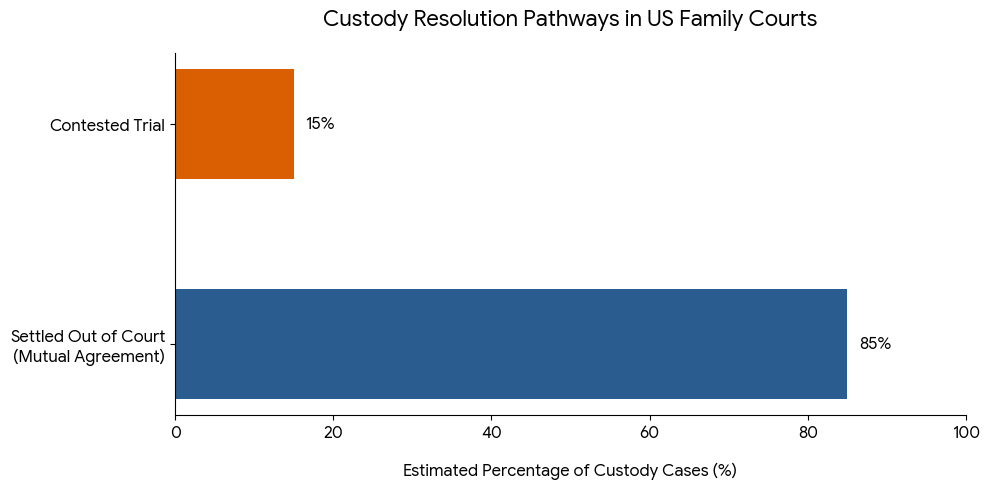
- About 85% of cases are settled out of court by agreement.
- About 15% of cases become contested matters decided through litigation.
In other words, many custody outcomes reflect parental bargaining, financial realities, safety concerns, work schedules, and strategic decisions made long before a judge issues any ruling.
Why Contested Cases Look Different
The minority of cases that do become contested are not representative of the average family court matter. These cases often involve serious factual disputes, competing narratives, and allegations that raise the stakes for both parents and children. In contested custody cases studied in the literature, approximately 38.5% include allegations of general abuse, and about 15% include allegations of child sexual abuse.
Contested custody litigation is a narrow and unusually high-conflict slice of family court practice, not the norm.
That context is important because broad claims about courts favoring one gender can be misleading when drawn from a population of cases that is already atypical and highly escalated.
What the Research Says About Outcomes
Available research on contested custody cases also complicates the idea that mothers are categorically favored. In the contested cases discussed in this body of research, mothers lose custody about 27% of the time when they allege general child abuse. When a case includes an alienation claim in addition to a child abuse allegation, that figure rises substantially, with mothers losing custody about 51% of the time.
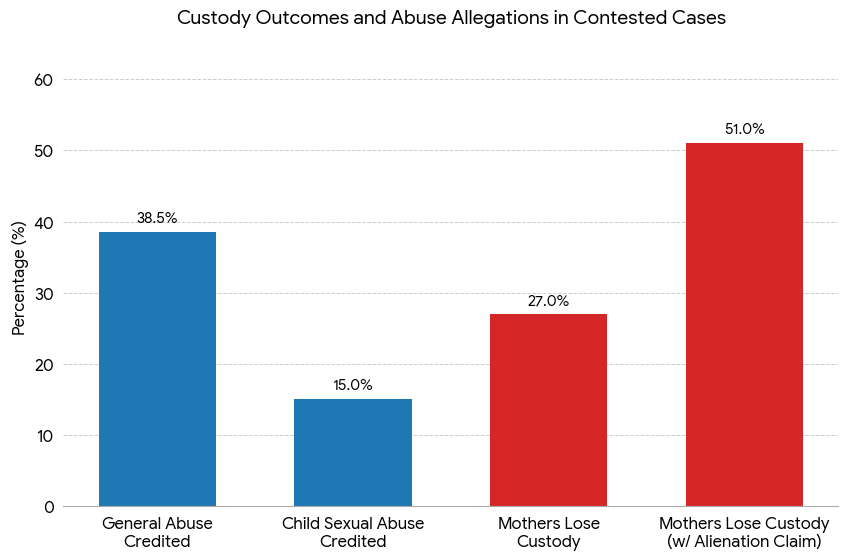
- In contested cases alleging general child abuse, mothers lose custody about 27% of the time.
- When there is a child abuse allegation plus an alienation claim, mothers lose custody about 51% of the time.
These figures do not prove that courts favor fathers, just as other statistics do not prove that courts favor mothers. What they do show is that the reality is more complex than a simple bias narrative. Outcomes can shift significantly depending on the allegations raised, the evidence presented, the credibility findings made by the court, and the legal standards applied in a given state.
The Better Question
Rather than asking whether family courts favor mothers as a rule, a better question is how custody decisions are shaped by settlement dynamics, litigation posture, evidentiary burdens, and child-safety concerns. Most families never receive a trial verdict. Of those that do, many are dealing with abuse allegations, alienation claims, or other severe conflict that makes simple generalizations unreliable.
For parents trying to understand the process, the takeaway is clear: custody outcomes are driven by far more than gender alone. Preparation, documentation, credibility, and case strategy matter. So does recognizing whether a case is likely to settle or become one of the relatively few disputes that a judge must decide.
References
- U.S. Census Bureau, Custodial Mothers and Fathers and Their Child Support (commonly cited in discussions of negotiated custody arrangements and parenting outcomes).
- Joan B. Kelly, Children’s Living Arrangements Following Separation and Divorce: Insights from Empirical and Clinical Research, Family Process 46(1) (2007).
- Joan S. Meier, Sean Dickson, Chris O’Sullivan, Leora Rosen & Jeffrey Hayes, Child Custody Outcomes in Cases Involving Parental Alienation and Abuse Allegations (George Washington University Law School, 2019).
- See also the National Center for State Courts and related family court research discussing the small proportion of cases that proceed to contested adjudication compared with those resolved by agreement.
If you are preparing for a custody dispute, strategic guidance can help you understand the process, organize your evidence, and make informed decisions before conflict escalates. Contact The Family Law Strategist to learn more.